Why Most GTM Plans Fail (And Why It's Usually a Leadership Problem)
A survival guide for founders who feel like they're sprinting… but not actually moving.
If you're a founder, this probably feels familiar:
One quarter, growth looks fine. Next quarter, activation drops. Then churn creeps up. Sales says leads are bad. Marketing says product isn't converting. Product says users don't "get it."
Cue the QBR panic.
Welcome to the GTM treadmill, where everyone is busy, everyone is smart, and nothing compounds.
Let's get one thing out of the way:
Most GTM plans don't fail because teams can't execute. They fail because leadership mixes incompatible go-to-market motions.
And then hopes alignment meetings will fix it.
GTM Is Not a Checklist. It's an Order of Operations.
Founders love GTM checklists:
- Messaging ✅
- Channels ✅
- Pricing ✅
- Sales enablement ✅
Looks solid. Feels responsible. Completely misses the point.
GTM isn't a list. It's a system of workflows — and workflows care deeply about sequence.
Specifically:
- Who experiences value first?
- Who approves spend?
- Who expands usage?
- Who churns first?
If you get the order wrong, no amount of optimization saves you.
The Core Failure Mode: Bottom-Up and Top-Down at the Same Time
This is the mistake I see most often.
Founders say: "We'll do PLG and sell to VPs."
Sounds ambitious. Feels optionality-maximizing. In reality, it creates GTM chaos.
Because bottom-up and top-down are not just different personas. They are opposite workflows.
Bottom-up GTM:
- User signs up
- User hits value fast
- Habit forms
- Team adoption grows
- VP approves later (because usage already exists)
Top-down GTM:
- VP buys first
- Budget is approved upfront
- Users are onboarded after
- Adoption depends on rollout, enablement, and enforcement
These flows are reversed.
Trying to run both — early, with the same infrastructure — creates Frankenstein GTM:
- Messaging gets watered down
- Onboarding satisfies no one
- Pricing feels wrong to everyone
- Sales doesn't know whether to hunt elephants or farm mice
- Product roadmap becomes a battleground

"But Slack / Notion / Figma Did Both"
Yes. They did.
After sequencing. After clarity. After pull existed.
They didn't experiment with both motions early. They earned the complexity.
If you're pre-PMF or displacing incumbents, trying both is not optionality — it's drag.
PLG Is Not "Freemium + Hope"
Let's kill this myth properly.
Having a free tier does not mean you're doing PLG.
PLG is not pricing. It's product + workflow design.
Real PLG requires:
- Fast time-to-value (minutes, not days)
- Clear "aha" moment
- Natural expansion trigger
- Pricing aligned to usage or value
- Data to track activation, not just signups
- Workflows that spread without permission
The litmus test: Does value appear before permission?
If your product needs heavy setup, change management, or executive mandate — it is not bottom-up friendly. Calling it PLG doesn't make it so.
The Root Cause: You're Designing Around Org Structure, Not User Journeys
Here's the uncomfortable truth:
Most GTM plans fail because founders ask:
- "Who owns this?"
- "How do we organize teams?"
Instead of asking:
- "Who experiences value first?"
- "What workflow delivers that value?"
You're optimizing for internal structure instead of external reality. And then wondering why nothing compounds.
The Silent Killer: Local Optimization Hell
This is where things really fall apart.
Week 1: Product notices activation is low → runs onboarding experiments
Week 3: Marketing sees CAC rising → A/B tests messaging
Week 5: Sales says leads are bad → changes pitch and ICP
Week 7: CS notices churn creeping up → adds manual interventions
Quarter end: Leadership is shocked. Metrics don't make sense. Everyone optimized their slice. The system broke.
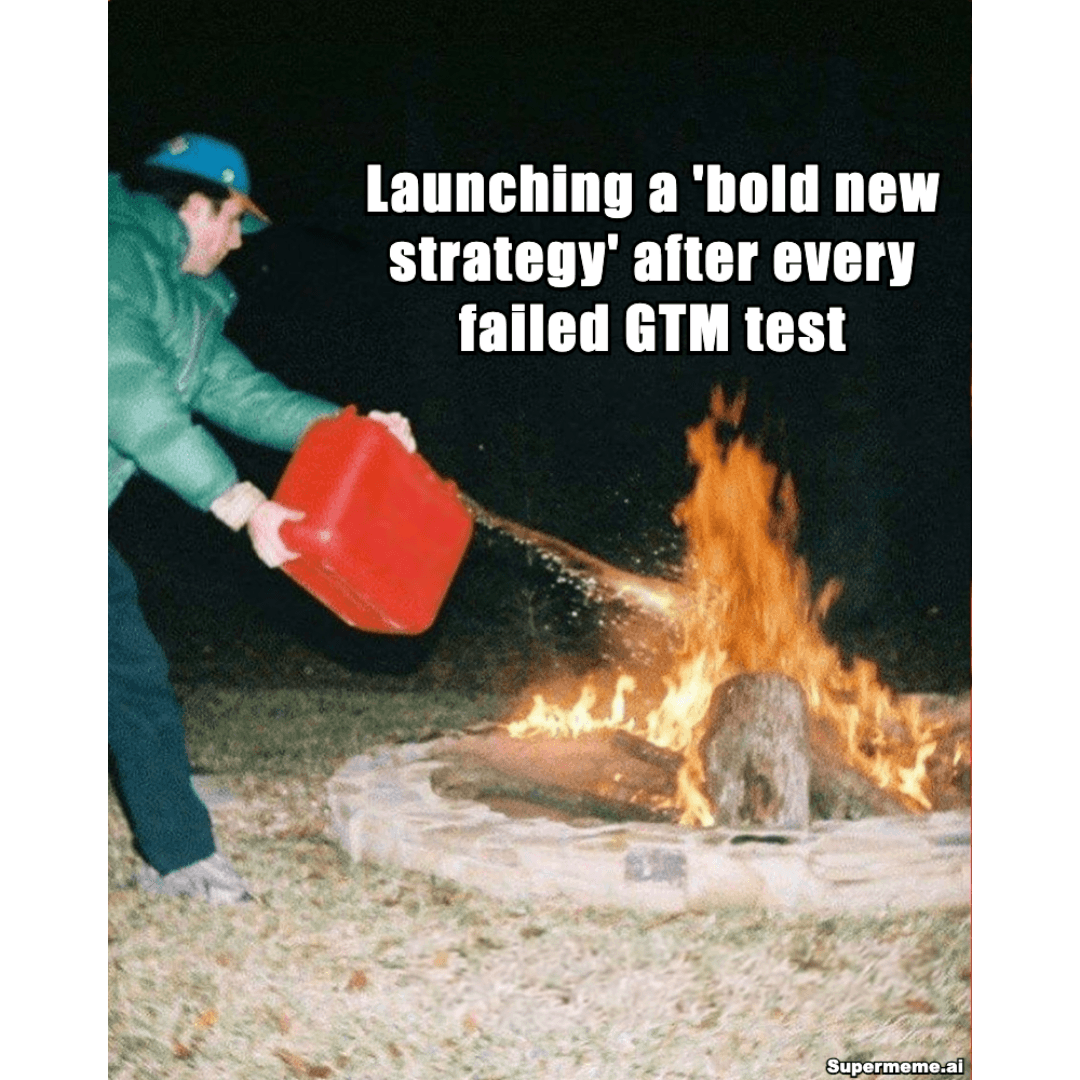
This isn't incompetence. It's local optimization without orchestration.
If teams only sync in QBRs, GTM is already months behind reality.
The Fix: System Optimization, Not Team Optimization
A GTM system only works if:
- Product changes inform marketing
- Marketing promises match onboarding
- Sales expectations match in-product reality
You don't need more meetings. You need one owner for end-to-end conversion.
The AI Reality: PMF Is No Longer Stable
Now add AI to the mix.
In AI, PMF isn't something you achieve. It's something you re-earn every quarter.
As Elena Verna brilliantly put it: AI companies are stuck in the "capabilities phase." Every model release redefines what "good" looks like. Capabilities shift fast. Customer expectations reset constantly. Messaging expires in weeks.
This breaks classic GTM playbooks:
- Long-term positioning
- Slow channel compounding
- Adjacent user expansion
Key GTM implication: When PMF is unstable, multi-motion GTM is lethal.
Each motion multiplies coordination cost. In AI, the winning move is usually:
- One motion
- Fastest learning loop
- Ruthless focus
Not elegance. Not scale. Not optionality.
GTM Is a Capital Allocation Problem (Not Just a Growth Problem)
Here's what founders consistently underestimate.
Every GTM channel requires runway, not just budget:
- SEO → 6–12 months of patience
- Outbound → people, tooling, management bandwidth
- Paid → cash + fast learning loops
- PLG → product, analytics, iteration cycles
Spreading thin across five channels doesn't hedge risk. It guarantees that none work.
Channels don't fail. Underfunded channels fail.
If you don't explicitly decide where your runway goes, your GTM plan is fiction.
So What Should Founders Actually Do?
1. Pick Your First Motion (Don't Blend It)
Ask one hard question:
Who experiences value before money?
If the answer is "users" → bottom-up. If the answer is "buyers" → top-down.
Pick one. Prove it. Then expand.
2. If You Run Both, Separate the Workflows
If you eventually do both, treat them like separate systems:
- Different onboarding paths
- Different pricing logic
- Different success metrics
- Different teams
- Shared infrastructure only where unavoidable
Never let enterprise needs slow PLG velocity. Never let PLG chaos scare enterprise buyers.
3. Install GTM Orchestration (Not Alignment)
That means:
- Shared metrics and dashboards
- Weekly GTM sync (not quarterly)
- Visibility into all experiments across teams
- One owner for end-to-end conversion
Optimize the system — not individual funnels.
4. Right-Size Your Channel Investment
Be brutally honest: You probably can't afford to do 4 channels well.
Pick 1-2. Staff them properly. Give them 6 months to work. Then expand.
The Founder Takeaway
Here it is, clean and simple:
GTM fails when leadership optimizes for optionality instead of coherence.
Bottom-up and top-down are not tactics. They are different orders of value, habit, and money.
Choose the order. Design the workflows. Fund them properly. Then scale.
Everything else is noise.
Want to talk through your specific GTM challenges? Drop a comment or reach out. These are the problems I love digging into with founders.
P.S. If this resonated, share it with a founder friend who's also tired of watching their GTM strategy implode every quarter. We're all in this together.